Photographing
Fish
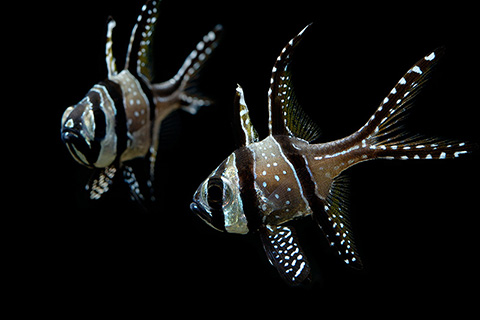 Think
of fish as extremely fast moving, self-propelled corals. Many of the same
techniques also apply to fish. In fact, all of them apply to fish. Some
additional techniques discussed in this section will help bag those sneaky buggers. Think
of fish as extremely fast moving, self-propelled corals. Many of the same
techniques also apply to fish. In fact, all of them apply to fish. Some
additional techniques discussed in this section will help bag those sneaky buggers.
Kill Circulation
Pumps
As with corals, killing circulation pumps has many benefits. One of which
is in the absence of current fish will swim slower and, consequently,
be easier to photograph. With strong currents fish zap back and forth
frolicking in the current and swimming about. When circulation is stopped,
they have a chance to relax and take a breather.
Use Fast Shutter
Speeds
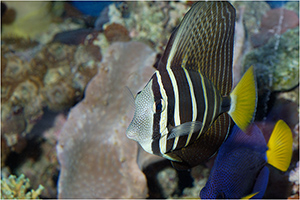 Fish move fast, no question about it. Capturing a swimming fish is a challenge
under the lighting conditions of most tanks. We will often have to increase
the ISO speed to get an aperture and shutter speed combination that will
work. Fish move fast, no question about it. Capturing a swimming fish is a challenge
under the lighting conditions of most tanks. We will often have to increase
the ISO speed to get an aperture and shutter speed combination that will
work.
Running-Man Mode:
Some digicams do not have ISO control, but offer scene modes. Using the
Running-Man mode tells the camera to place emphasis on a higher shutter
speed in order to freeze motion. |
Focus Lock
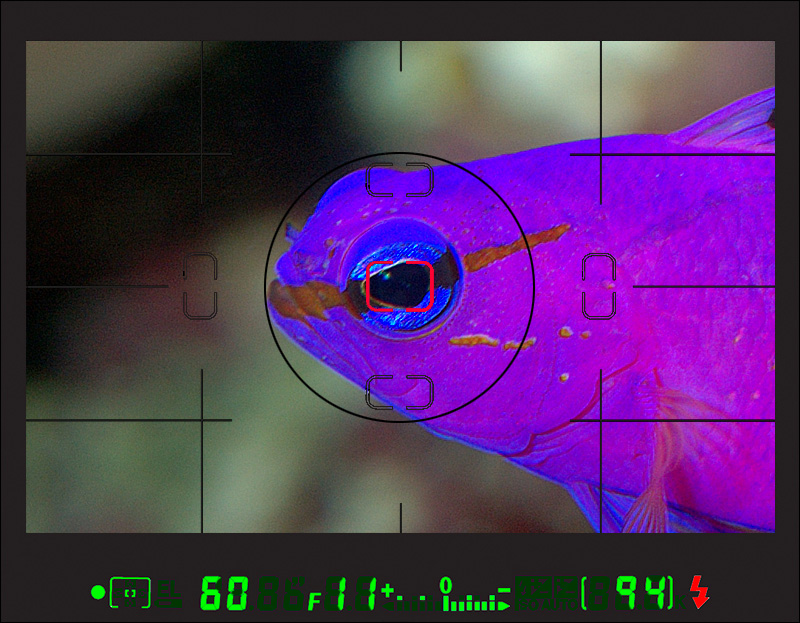
on the Fish's Eyes
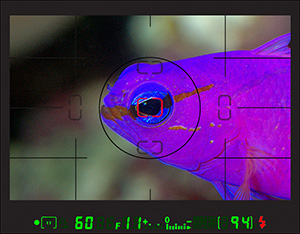 Say
what? I have trouble keeping the fish in the viewfinder, let alone being
able to stick the focus brackets on the eyes! Say
what? I have trouble keeping the fish in the viewfinder, let alone being
able to stick the focus brackets on the eyes!
When we look at animate creatures, we look to the
eyes for emotion. If the eyes are in focus the photo will grab our
attention. Conversely, if the entire fish is sharp, but the
eyes are out-of-focus, we lose touch with the subject.
When aiming the camera, instead of aiming for the
middle of the body, try aiming at the eye. We have to aim somewhere,
do we not? This way, when we do capture a shot of the fish, the eyes should
be in focus.
Again, with the pumps off the fish will move slower,
and allow us more time to frame and focus, and aiming for the eyes
becomes easier.
Manual focus: If the camera supports
manual focus, this is the ideal situation in which to use it. The
human hand-eye reflex action is much quicker than even the fastest
autofocus system. We can simply track the fish while it is swimming
and make constant fine adjustments to keep the fish in focus for the
entire duration.
|
Take Lots
of Shots
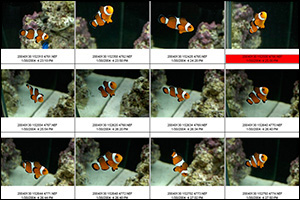 A
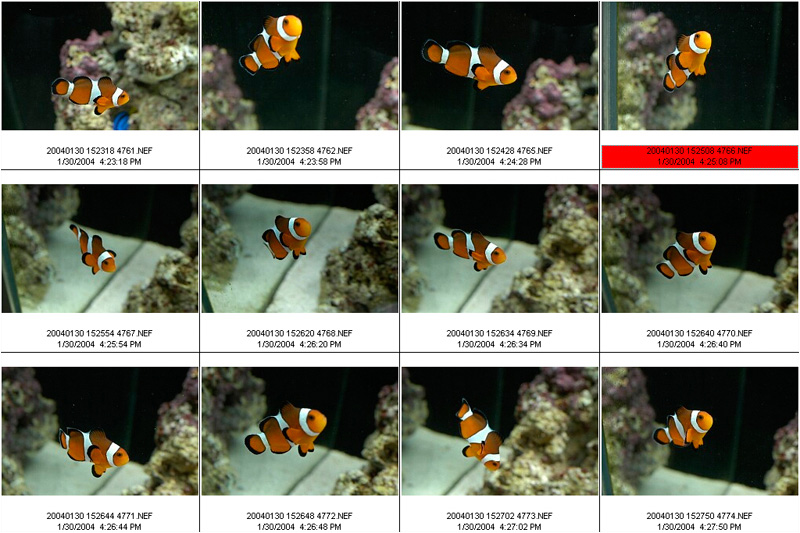
big plus to shooting digital is that mistakes are free. We can shoot
a single subject hundreds and even thousands of times to get the shot
we want. By simply reviewing the captures, we know if we got
what we were after. A
big plus to shooting digital is that mistakes are free. We can shoot
a single subject hundreds and even thousands of times to get the shot
we want. By simply reviewing the captures, we know if we got
what we were after.
Although this may sound like a brute force method,
professionals do this quite frequently. Ever wonder why they go
through so many frames? Having more choices to choose from helps
assure us we got the shot we set out to capture. |
Interaction
with the Environment
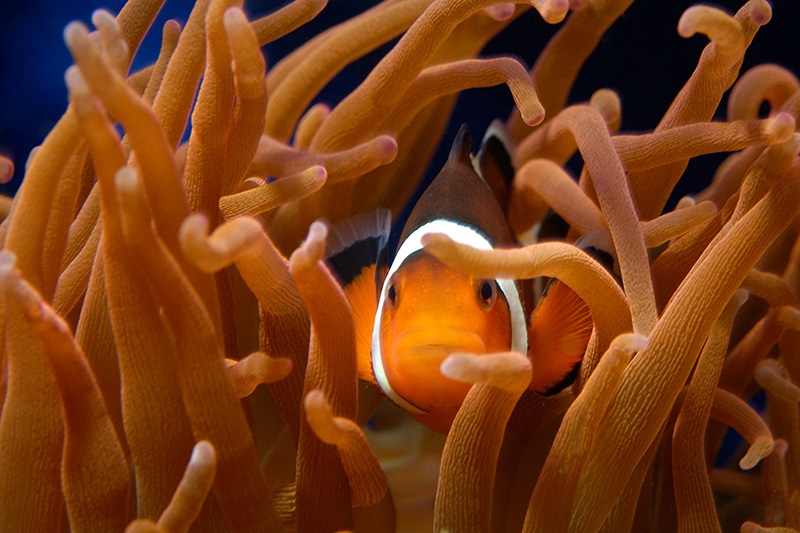
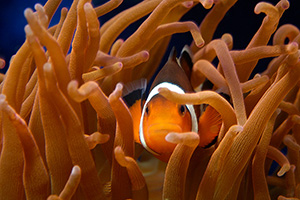 So we want that perfect shot of the
anemone hosting its clown.
We chase the clown around the entire tank and back, snapping several
hundred photos in the process. With the in-focused shots, the clown is
all over the tank, but not where we want. The shots where the clown
is in the anemone are
all blurry. There is a better approach. So we want that perfect shot of the
anemone hosting its clown.
We chase the clown around the entire tank and back, snapping several
hundred photos in the process. With the in-focused shots, the clown is
all over the tank, but not where we want. The shots where the clown
is in the anemone are
all blurry. There is a better approach.
Set up the shot: Frame the anemone where we want,
take some test photos and make sure the DOF is appropriate, the shutter
speed is fast enough and the image is properly exposed. Then pre-focus
on the spot were the clown will be in the final photograph.
Shutter lag is the length of time from when you press
the shutter release to when the image is actually recorded. A majority
of this time is attributed to the time it takes to focus the camera.
It is the slowest
part of the image capturing process since it involves actual mechanical
movement versus electronic delays.
When we initiate autofocus, the contrast detection
system moves elements back and forth (hunting) until it detects a high
contrast edge. Depending on where the lense elements are when this process
begins, it can take a significant amount of time. By pre-focusing, we get the lense elements in the
approximate position needed for the capture. This reduces the amount
of movement necessary to achieve fine focus and, therefore, reduces shutter lag.
Now we wait. Observe the fish. By observing the fish,
we learn about its behavior and swim patterns. We can use this information
to set up future shots. When the clown finally does make its
appearance in the anemone, we simply half-press the shutter release to achieve fine focus and shoot. |
|